OpenAI tells you not to build your own harness
Harness engineering is all the hype now, so on this week on the podcast we're looking back to an article written by OpenAI in February about harness engineering, "Harness engineering: leveraging Codex in an agent-first world". In this article, they claim that the era of "hand-written code" is officially over. We break down their experiment of shipping a million-line product with zero manual coding, shifting the human role from "coder" to "environment designer."
Project details
Open in GitHubA breakdown of OpenAI's harness engineering article and Ryan Lopopolo's claim that custom coding harnesses will be "bitter lessened away" — plus why Dex and Vaibhav think the labs don't actually own this space as firmly as they claim.
Episode Highlights
"While alternative coding harnesses may have short-term lift, they will be bitter lessened away. I am bearish on any harness that doesn't come from the lab whose model you are using. You're fighting against post-training." — Ryan Lopopolo, OpenAI
"As long as you know the shape of the call that the model prefers to make, nothing prevents you from having the model make that shape of call. There's nothing."
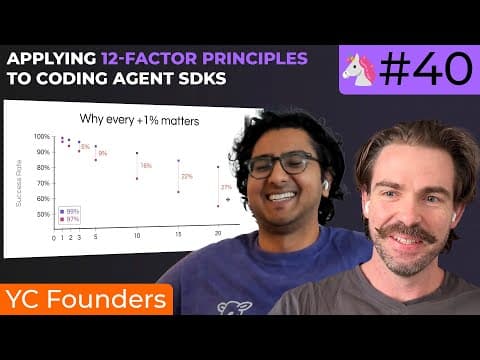
"If you're doing 500 tool calls on a coding agent task, [a 1% accuracy drop] compounds real fast."
"Your job is not to build any one while loop. Your job is to always build the next while loop."
"It's the velocity, not the position."
"Your skill set is your ability to understand core concepts and reapply them over and over again in a very different way."
Key Takeaways
- Post-training gives labs a real but narrow edge. When a lab post-trains a model on a specific tool call format (like Claude Code's
old_string/new_stringedit tool), the model gets slightly better at that exact shape. Across hundreds of tool calls in a coding task, even a 1% improvement compounds hard. But "slightly better" is the honest framing — these models are general enough that switching formats doesn't crater performance. - The harness runs on your machine, which means the API surface is always observable. Any alpha a lab bakes into tool call formats is inspectable by proxying the LLM API. You can disassemble binaries, trace syscalls, or just ask an agent to reverse-engineer a minified harness. Secrets don't stay secret when user code runs in user environments.
- The real edge lives in the outer harness, not the inner one. Inner harness (tool definitions, implementations) is where labs have post-training leverage. Outer harness — orchestration, stacking while loops, injecting domain context — is where builders have alpha. An outer loop that knows your team's engineering workflow will outperform a generic inner loop every time.
- For complex data types, the labs haven't caught up. Recursive types, discriminated unions, deeply nested schemas — there's less training data for these, which means custom structured output solutions (BAML, DSPy) can outperform the model's native tool calling on these specific cases.
- Surfing the releases is a skill. New model drops, you context-engineer on top of it faster than the training cycle. The models change every few months. What lasts is the velocity: your ability to understand fundamentals and rebuild on top of whatever ships next.
Resources
- Session Recording
- GitHub Repo
- Discord Community
- Sign up for the next session on Luma